Gubor Schokoladen GmbH
FLAG emissions along the supply chain Customer: Gubor Schokoladen GmbH…

The DFGE turns calculating the Corporate Carbon Footprint into child’s play
The recording of climate-relevant emissions generated in your company and at your sites has always been THE key figure for sustainability.
Regardless of regulations such as the Corporate Sustainability Reporting Directive (CSRD), the European Sustainability Reporting Standards (ESRS), the upcoming ESRS E1, or the Voluntary Sustainability Reporting Standard for SMEs (VSME), the Corporate Carbon Footprint (CCF) is the starting point for all your efforts to stop climate change.
It is a prerequisite for required Product Carbon Footprints, participation in CDP, EcoVadis or for setting climate targets for SBTi. Simple recording according to GHG and non-consideration of Scope 3 emissions are no longer acceptable. A valid calculation is time-consuming and costly, as a lack of data availability, numerous locations and extensive value chains make what is actually simple mathematics complex.
With its top-down method, DFGE shortens and simplifies the calculation of the Carbon Footprint for companies. We select the critical influencing factors for you, use benchmark data and take accessible financial data into account. In this way, a reliable value for company-wide greenhouse gas emissions can be determined in a short space of time – a Corporate Carbon Footprint that also stands up to critical external scrutiny.
Your support for decarbonization
Successful CCF customer projects

FLAG emissions along the supply chain Customer: Gubor Schokoladen GmbH…

Climate Strategy in focus incl. CCF, PCF, SBT Customer: Huf…

Corporate Carbon Footprint for Dierig Holding AG Customer: Dierig Holding…

CSRD-Readiness for Lohmann Group Customer: Lohmann GmbH + Co. KG…

The journey of the swabian family-owned company to a transparent…

DFGE as a full-service provider: Corporate Carbon Footprint, EcoVadis &…
Why you should contact DFGE to calculate the Carbon Footprint for your company
FAQ | Scopes & weitere Informationen
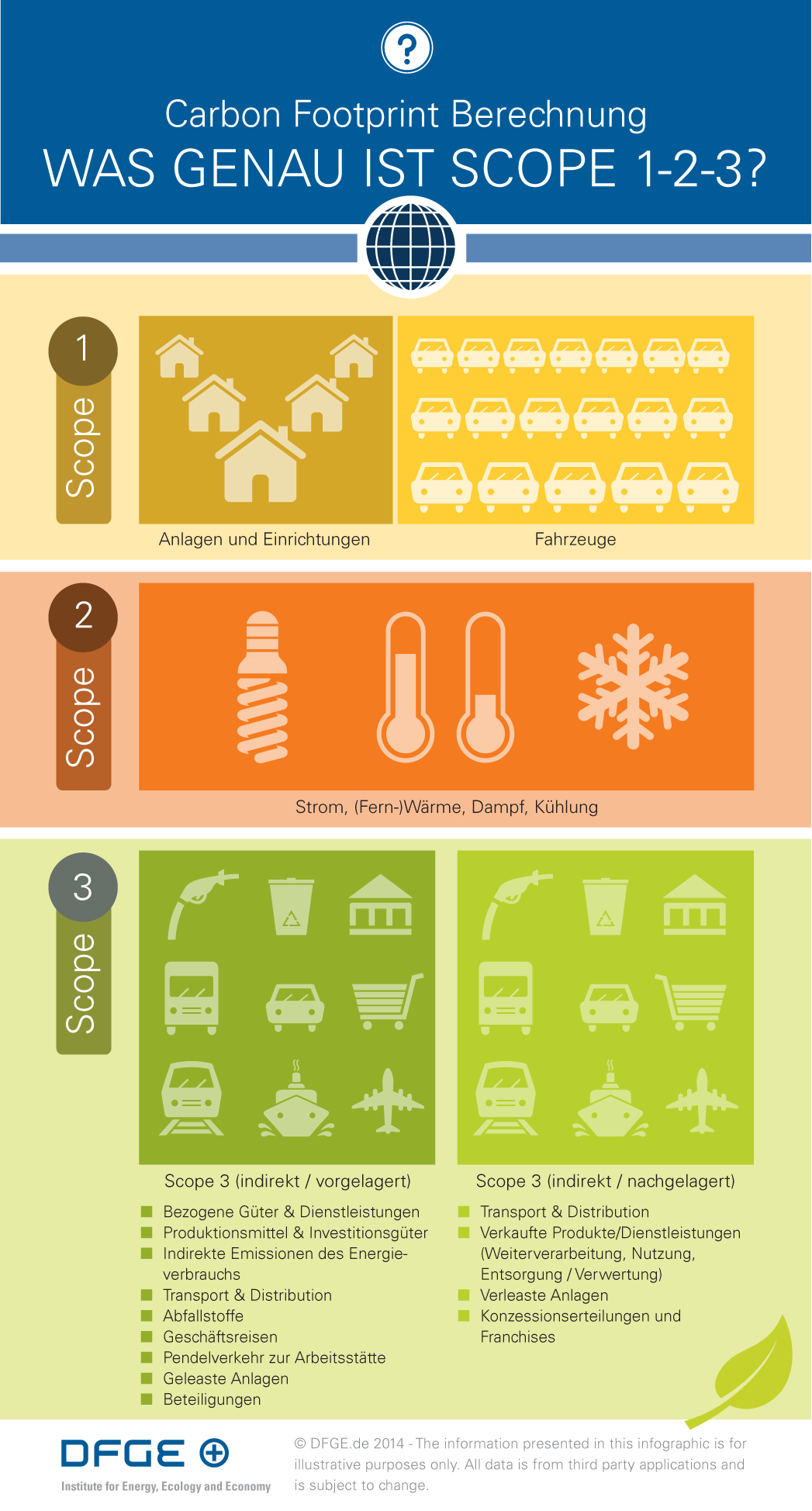
What does Scope 1 mean?
Scope 1 covers all direct greenhouse gas (GHG) emissions from sources that are owned or controlled by the company.
Where do these emissions occur?
They arise directly from business operations – wherever fuels are combusted or industrial processes take place within the organization’s operational boundaries.
Typical examples of Scope 1 emissions:
Combustion of natural gas, heating oil, or diesel in company-owned facilities
Emissions from company-owned vehicles
Process-related emissions (e.g., chemical reactions in manufacturing)
Leakage of refrigerants from air conditioning or cooling systems
Why is Scope 1 important?
These emissions are under the company’s direct control. They can be reduced through efficiency improvements, electrification, alternative fuels, or transitioning to renewable energy sources.
What does Scope 2 mean?
Scope 2 includes indirect GHG emissions from the generation of purchased energy that the company consumes.
Why are they considered indirect?
The emissions physically occur at the energy producer’s facilities, not on-site at the company. However, they are attributed to the company because they result from its energy demand.
Typical examples of Scope 2 emissions:
Purchased electricity
District heating or cooling
Purchased steam used in production processes
Why is Scope 2 important?
Energy consumption is often a significant contributor to a company’s carbon footprint. Switching to renewable electricity, entering power purchase agreements (PPAs), or improving energy efficiency can substantially reduce Scope 2 emissions.
What does Scope 3 mean?
Scope 3 includes all other indirect emissions that occur across the company’s value chain — both upstream and downstream — and are not included in Scope 1 or Scope 2.
Why is Scope 3 so comprehensive?
It covers emissions resulting from activities that the company does not directly own or control but that are connected to its operations.
Typical examples of Scope 3 emissions:
Production of purchased goods and services
Transportation and distribution
Business travel and employee commuting
Use of sold products
End-of-life treatment, recycling, or disposal of products
Why is Scope 3 important?
For many industries, Scope 3 represents the largest share of total emissions. Meaningful climate action therefore requires engagement with suppliers, product design improvements, and consideration of the full product life cycle.
The English term carbon footprint (CF) has also become established in Germany and is increasingly replacing the terms CO2 footprint and CO2 balance. It represents the sum of all carbon dioxide emissions (measured in CO₂) and greenhouse gas emissions (measured in CO₂ equivalents, CO₂-eq) that a company, product or service causes directly and indirectly over a defined period of time or over its life cycle.
Determining an emissions balance is necessary in order to measure the impact on the climate caused by companies and products. Ecological weak points and drivers of emissions can be discovered and optimized during the recording and calculation process. The calculated value of the carbon footprint then serves as a benchmark that needs to be reduced in order to achieve international and national climate targets.